Quick: name three Japanese composers. A few of the more adventurous music lovers among us might come up with Toru Takemitsu, but that’s about it. There are, of course, many, and the reason for their obscurity is a question worth exploring. What can’t be denied, however, is that classical music is huge in Japan, and its capital, Tokyo, is one the best places in the world to listen to it.
Two things must be said about the Tokyo classical music scene; it’s exciting and expensive. Ignoring the latter for the moment, the number of concerts is a classical music fans’ dream come true. Orchestral concerts (7 professional orchestras!), recitals, and operas are performed in and around Tokyo almost every day. The city can also boast an impressive list of international artists stopping over for a few performances. (Wagner’s Ring Cycle played by Daniel Barenboim and the Berlin Staatsoper during their 2002 visit being a personal favorite.)
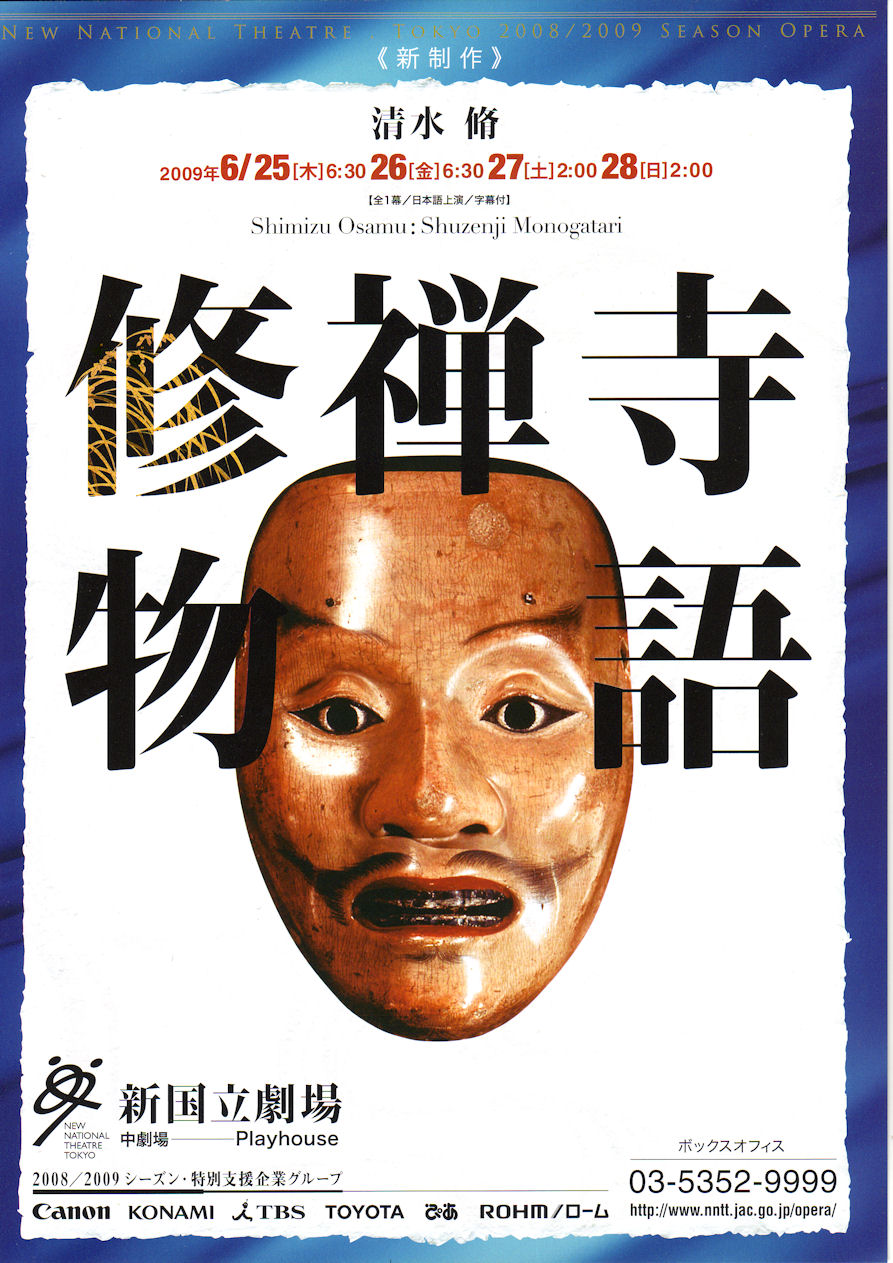
Surprisingly, even Tokyo rarely bothers to present music from Japanese composers. That being said, the New National Theater, the city’s excellent opera house, recently staged an opera by Osamu Shimizu (1911-1986), Shuzenji Monogatari (Tales from Shuzenji Temple). Based on a famous kabuki play, it tells the story of a famous mask maker troubled by a project to make a mask for a powerful and feared local samurai. Here’s the lowdown on the production.
STORY: Great. Without going into too much detail (synopsis can be found here) there was much to think about. In particular, the scene where the mask maker realizes his masks are foreshadowing the samurai’s death. He sings about his genius while his daughter lay dying. It was riveting. The end was also moving. The mask maker, having always desired to capture the expression of a dying girl, sets down to sketch his daughters face.
MUSIC: Not bad, but not great. Sounded a little like movie music. Strangely, there was nothing that identified it as “Japanese”. A missed chance I would have thought, but perhaps that was the point; avoid any obvious connection to the kabuki origin. Too bad, it would have been nice to hear some Japanese percussion or winds to create some much needed atmosphere. The Tokyo Symphony Orchestra played wonderfully (they always do), and the singing was generally strong.
SETS & COSTUMES: Pretty good. Traditional Japanese house (polished wood, tatami, etc...) in the first act. A bridge by a river started the second. The costumes, again traditional, were also well done.
STAGING: Meh. Pretty underwhelming, which was odd as a famous kabuki actor, Sakata Tojuro, was the director. The singers spent a lot of time sitting in a straight line at stage front. The one action packed scene, a fight where the assassins try to kill the samurai, wasn’t terribly exciting either. Sakata has a long connection with the play, and maybe someone with more knowledge of its performance history would have a different reaction than mine. I won’t say it was boring, but it was static.
So, that was my first experience of Japanese opera. I can’t say I loved it, but it was interesting. My wife and I are both eager to see a kabuki performance of the story, and compare the two.
I should also mention that the New National Theatre should be proud of their excellent opera company, and I hope to post some stuff about the operas from last season: Das Rheingold, Die Walkure, Lady Macbeth of Mtsensk, and La Cenerentola in the near future.